BIRGEJUPMI: Bridging Knowledge Systems for Inclusive, Resilient, and Prosperous Arctic Coastal Futures
Duration
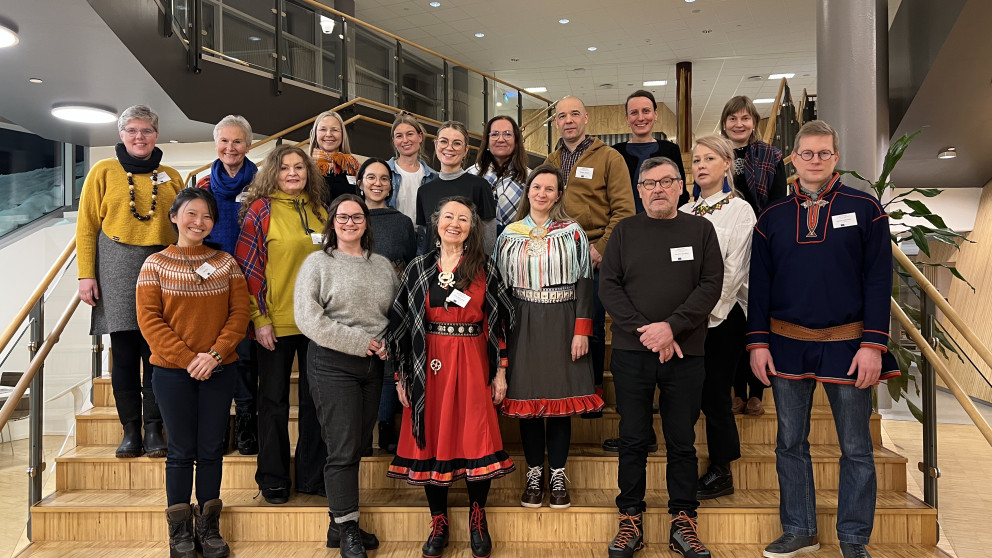
The reIMAGINE Arctic Research group is a member ofof BIRGEJUPMI: Bridging Knowledge Systems for Inclusive, Resilient, and Prosperous Arctic Coastal Futures, which is the first EU-Horizon project led largely by Indigenous scholars, practitioners and institutions. BIRGEJUPMI aims to strengthen community engagement, Indigenous knowledge, and environmental decision-making in Arctic coastal regions in Sápmi and Kalaallit Nunaat by bridging Indigenous, local and Western knowledge systems. The project adopts a decolonial, holistic, and community-based perspective.
The work of the participating RIFS researchers focuses on 1.) Applying and further developing ethical, collaborative, and inclusive research approaches and methodologies for working across different knowledge systems (WP1 and WP10) 2.) Creating spaces for young people in Sápmi to explore how climate change mitigation measures affect everyday life and how this relates to their visions for the future.
The name of the project, BIRGEJUPMI, is a Northern Sámi word indicating the interconnectedness of lives (human, animal and plants) and the ways to manage/get by — the idea of self-sufficiency. It embodies the principle of taking only what is necessary from nature, ensuring the ability to harvest again in the future.
BIRGEJUPMI is led by the University of Oulu, and will be carried out in partnership with Sámi Allaskuvla, the Saami Council, the Indigenous Voices Research Group (IVO) at the Arctic University of Norway (UiT), Alta Museum, Dáiddadállu, Ikitsivik, Psykolog Paarnaq, Árvu AS, the University of Tartu, National Dong HWA University, and RIFS. This research focuses on three Arctic regions: western Sápmi, northern Sápmi (Norway) and Kalaallit Nunaat (Greenland). BIRGEJUPMI builds on long-standing relationships among the consortium partners, including their work together in the DÁVGI project.
ETHICAL, COLLABORATIVE, AND INCLUSIVE RESEARCH APPROACHES, METHODOLOGIES, AND EVALUATION FRAMEWORKS
RIFS researchers, together with the Saami Council and the University of Oulu, contribute to Work Packages 1 and 10. Both of these focus on ethical, collaborative, and inclusive research approaches, methodologies, and evaluation frameworks. The goal of WP1 is to create a research infrastructure for researchers and communities engaged in the project to consistently evaluate its progress, adopted methods, and the quality of research collaborations. To do this, different methodological approaches to knowledge co-production and evaluation will be mapped from a multi-actor perspective. This iterative process aims to promote ethical and equitable research practices aimed at empowering researchers and communities across all work packages for the duration of the BIRGEJUPMI project.
The project’s work packages are interconnected. WP10 draws on the outputs of WP 1, for example, to establish a space for reflexive ethics assessment and engagement with methodological approaches. This work will support the development and application of co-creative/co-productive and collaborative methods and promote ethical and context-appropriate research practices and contributing to meaningful outputs. The insights generated through this work will be shared within the consortium to facilitate the fine-tuning of research methods, processes, and outcomes, and contribute to the development of new ethical and equitable research practices.
Lessons learned will contribute to improving co-productive and transdisciplinary research approaches and evaluation practices that are vital to research performed at RIFS.
WP4 looks at the energy transition in the European Arctic and how it is negotiated by young people in North Sápmi
Together with the Saami Council, our research group is co-leading WP4 Local and global futures: young people’s visions of sustainable livelihoods and inclusive environmental decision-making. The aim of this work package is to assess the impacts — as experienced by young people in the municipalities of Unjárga/Nesseby and Bieralváhki/Berlevåg — of measures to mitigate climate change, such as the development of Green Transition infrastructure (onshore wind parks etc.). Researchers will collaborate with young people to co-design and co-curate a space in which they can share experiences of climate change, mitigation measures, and their visions for a sustainable future. The expansion of renewable energy infrastructure in this region, driven by European demand for green energy, directly impacts local communities and is referred to by Sámi scholars and activists as "green colonialism". Even as German communities resist plans for wind farms in their vicinities, German utilities (such as Stadtwerke Munich) are investing in wind projects in Sápmi, thereby externalizing the impacts of the Green Transition. This connection – metaphorically approaching the subject from two ends of the power lines – is of particular interest to the reIMAGINE group.
Building on this work, WP8 Mobilizing youth leadership and exchange for shaping socio-economic transitions in Arctic coastal regions linked to the EU Green Deal will focus on the development of an infrastructure of knowledge exchange between actors at the local, national, and EU-level about the way young people navigate the changes and challenges that climate change mitigation strategies bring to their lives. In doing so, WP8 will further explore concepts and practices of solidarity.
Funding information
The BIRGEJUPMI project has received funding from the European Union's Horizon Europe research and innovation programme under grant agreement No 101182041.