An Undervalued Engine for Change: Cooperative Economics for a Just Transition
19.01.2026

The cooperative economy, the democratic economy, commoning, and the economy for the common good — these different terms share a common core. In our panel at the RIFS Conference 2025, we used the collective term “social and solidarity economy” (SSE), which is also used at the European and international levels. The term refers to a variety of practices and organisations — from cooperatives, associations, social enterprises, resource centres and neighbourhood businesses to community energy and community-supported agriculture.
This blog post is part of a series on the 2025 RIFS Conference "Tough Conversations in Tough Times".
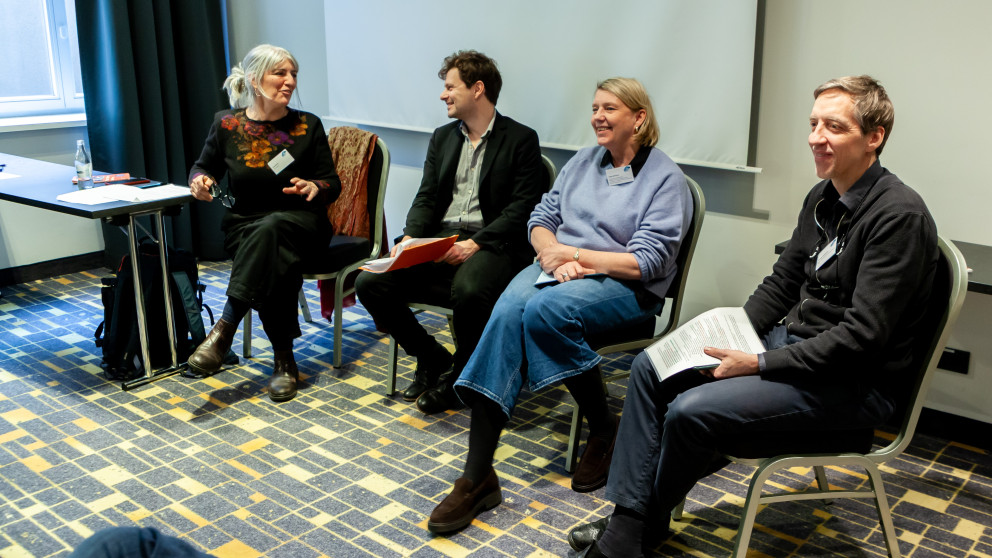
Held on 4 December 2025, the panel brought together Florentin Letissier (Deputy Mayor of Paris), Heike Birkhölzer (Technologie-Netzwerk Berlin e.V., Social Economy Berlin/Verbund Kooperatives Wirtschaften) and Christian Lautermann (Institute for Ecological Economy Research, IÖW).
Drawing on experiences from across Germany and France, our discussion revolved around a guiding question:
What can the social and solidarity economy do that the conventional economy cannot?
The short answer to this is that it can anchor value creation and decision-making power where their impacts are felt: among consumers, producers and direct stakeholders, in neighbourhoods, cities and regions. The social and solidarity economy is not just "a nicer version" of economic activity, but replaces competition and profit maximisation at all costs with a logic that prioritizes democratic governance, embedding production and consumption locally, reinvestment of surpluses in the common good and a practice that simultaneously addresses social cohesion and ecological resilience. Crucially, in this time of polycrisis, energy and food security, repair and reuse structures, cooperative logistics, care work or climate adaptation are transformation fields in which "more market" alone often does not deliver — and "more state" comes under pressure or tends towards authoritarianism.
SSE is also politically relevant because it facilitates local and regional action even when progress is hindered at the national level by political constraints, shifting priorities, or short-term funding. Cities and regions can (and must) become spaces for experimentation: as places where new alliances are formed, basic services are reorganised and transformation can be experienced in practice. The panel began by asking the audience: "Where have you already encountered SSE — and in which sector?". The answers ranged from community energy and community-supported agriculture to repair and reuse initiatives. These responses showed that SSE is less a niche label than an everyday infrastructure that is often invisible, but highly effective.
France and Germany in comparison: recognition versus fragmentation
The deputy mayor of Paris, Letissier, explained how legal and administrative recognition can facilitate scaling: In France, SSE is legally defined as an "entrepreneurial mode". Paris strategically links SSE with the circular economy — as a production method that protects resources in a socially responsible way and avoids waste. In the metropolitan region, around 70,000 jobs are directly linked to circular activities, and value creation is also visualised as an economic factor. Paris works with a "toolbox" of funding programmes, project calls, utilization of space and real estate, rent reductions and formats such as the annual SSE trophies, which reward projects and stimulate demand.
As Birkhölzer and Lautermann explained, the situation is very different in Germany, where the social and solidarity economy is not identified with a specific sector and instead spans the social sector, civil society, and SMEs — with legal, statistical and policy implications. As a consequence, its economic significance and transformative potential often remain invisible and are insufficiently recognised in funding, economic and innovation policies. Lautermann did note some progress, in particular the 2023 National Strategy for Social Innovation and Enterprises for the Common Good, which aims to systematically strengthen social innovation and public-interest companies and ensure they become an integral part of innovation and economic policy. At the same time, the debate is often dominated by a narrow concept of social entrepreneurship that does not properly reflect the nature of the "social economy", which is historically strongly rooted in the welfare state. Both conceal the breadth of co-operative economic activity. Birkhölzer added historical context, noting that Germany's post-war prosperity and political ruptures in cooperative traditions (resulting from the experience of Nazi tyranny and the dictatorship in the GDR) continue to have a sceptical effect on collective, democratic economic activity to this day. As a consequence, the SSE in Germany remains a fragmented field, lacking political recognition as a unified sector for transformation.
Cities as infrastructures of transformation — even in the face of opposition from above
A key takeaway: Cities can continue to act even amidst fluctuating national conditions, leveraging tools such as procurement, land policy, funding instruments, local networks, and permanent support structures. For example: the regional platform Social Economy Berlin provides advisory services, facilitates networking, and supports engagement with public agencies, commerce and industry chambers, funding institutions and actors in the field — as well as advocating for public procurement policies that grant cooperative companies realistic opportunities. As an example, Lautermann explained that the SSE in Bremen operates across sectors and can be economically independent — however scaling up entities requires targeted support through knowledge transfer and networks.
Three key insights
Together, the panellists identified three measures to strengthen cooperative economic activity:
- Recognise and measure: Germany should adopt a clear definition of the SSE, systematically map its impacts, and invest in research and development. This would acknowledge the role of the SSE as a transformative sector, rather than just a ‘social project’ or ‘special start-up’.
- Strengthen the municipal toolbox: Public procurement policy, framework agreements, access to space, and long-term rental models should support the SSE and provide planning security by shifting away from project-based funding towards a focus on infrastructure.
- Organise cooperation: SSE organisations are evolving from isolated entities into collaborative ecosystems by establishing collective structures such as associations, umbrella cooperatives and social franchise approaches. For example, the Bürgerwerke (citizen energy) and Mietshäusersyndikat (community-owned housing) platforms show how shared ownership and financing can create resilience.
The panel’s final takeaway was that true citizenship must include economic empowerment alongside political rights. Ensuring a just transformation demands that democratically-driven economic activities be integrated into modern public services and efforts to build resilience on the ground through cooperation and a focus on effective results.