Are we currently facing the ‘end of reason’?
11.12.2025

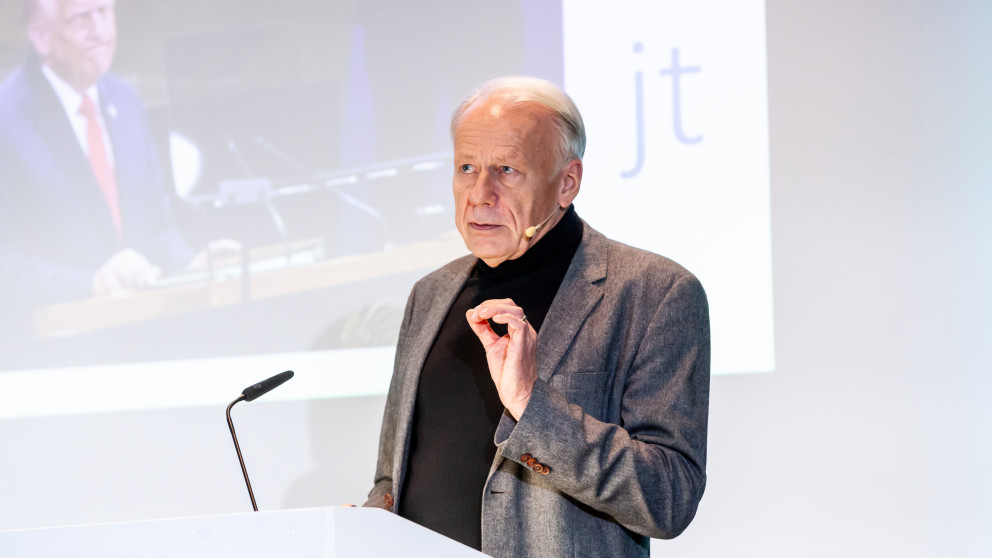
In his keynote speech at the inaugural RIFS conference, Jürgen Trittin, former Federal German Minister for the Environment and long-serving politician with Alliance 90/The Greens, analysed the development of the climate debate from broad consensus to deep polarisation. He opened with the question of whether we are facing the "end of reason". He then explained that the climate debate is now dominated by a well-organised minority that deliberately stir up fears and deny facts. This group, supported by the fossil fuel lobby, uses the media, social media algorithms and populist rhetoric to divide the public.
This blog post is part of a series on the RIFS Conference 2025, "Tough Conversations in Tough Times".
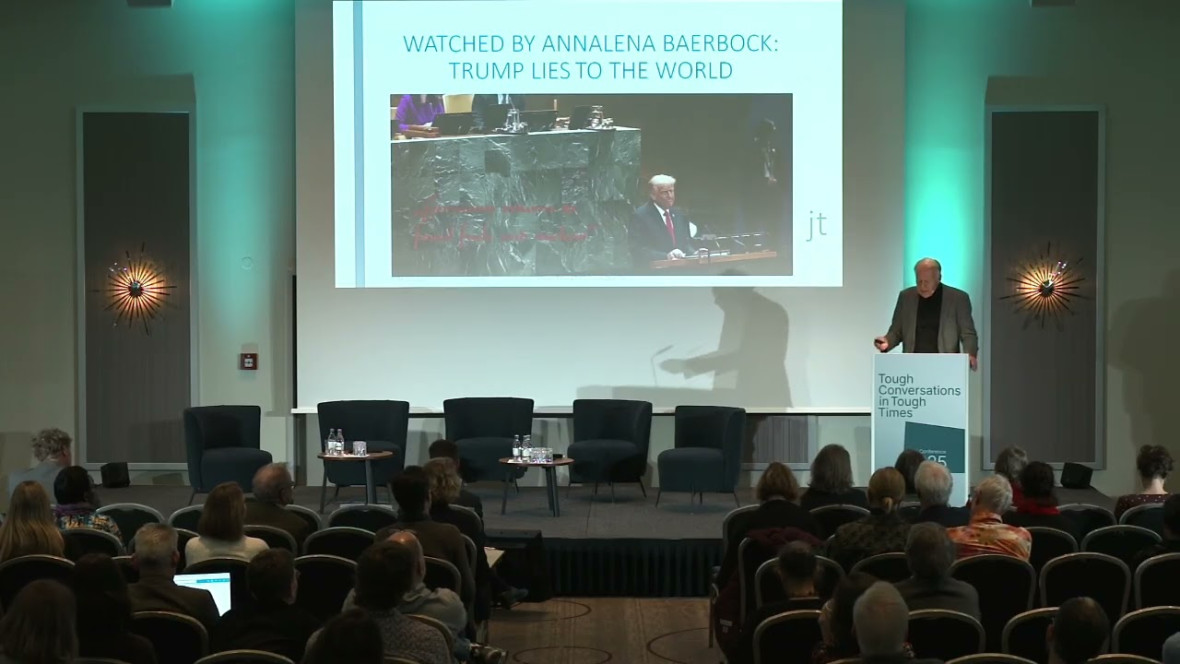
Trittin warned that public trust in science had been shaken by targeted attacks, in particular under the Trump administration. Trump's strategy, he said, is to use fossil fuel dominance as a political symbol – quote: "Drill, baby, drill." For example, he is blocking renewable energy, subsidising coal mining and launching massive attacks on scientific freedom. The US and Russia both base their power on fossil fuels – and both have "energy dominance as a national cornerstone". Trump uses lies as a political tool. Similar strategies can be observed in Europe, for example in the debate over Germany's heating transition, where false claims have been used to manipulate public opinion.
To back this up, Trittin used statistics that show the change: in 2019, 68 per cent of Germans thought climate protection was "very important," but by 2025, it was only 54 per cent. Eight per cent of the population now deny climate change, while 18 per cent are considered "committed to climate protection". In a ranking of public concerns, the climate emergency has fallen from fourth place (2019) to eighth place (2025). Through a combination of fear, hatred and the identification of a common enemy – from the "left-wing elite" to migrants, LGBTQ people and vegans – the right-wing movement is creating a narrative framework that portrays climate protection as a threat. However, Trittin rejected the use of fear as a tool in climate communication, as it evokes resignation rather than leading to action.
A look at global developments
But there are also positive developments: renewable energy capacities grew by 585 GW in 2023, accounting for 92 per cent of total power expansion globally that year, while fossil energy made up just 7.5 per cent of new capacity. Investments in green technologies are mostly outstripping fossil fuel subsidies, especially in China, which now invests more in clean energy than Europe and the US combined. Despite this progress, regressive trends now dominate political debate in many democratic countries.
A central argument advanced by Trittin was that notions of justice are no longer centred on the principle of equality of opportunity. Instead, it is increasingly perceived as fair when “others are worse off”. This redefinition, he suggested, fuels right-wing populism and encourages a retreat into nostalgic role models, most notably the ideal of the male breadwinner.
Media
Facts, lies, feelings — tough times for science. Keynote by Jürgen Trittin
Trittin's theories for the future
- A polarising minority dominates the discourse, but it does not command a majority.
- Values such as ecological sustainability are universal, but they are no longer collectively embraced and practised.
- Dystopian scenarios breed resignation rather than a sense of agency.
- The benefits of climate action lie in new jobs, affordable energy and technological sovereignty.
- An independent Europe committed to renewable energy can regain geopolitical autonomy.
- Academic freedom must be defended; only then, he argued, can climate change be addressed effectively.
Trittin concluded with an appeal to abolish the "belief in fire" – the ideological glorification of fossil fuels – and instead pursue a forward-looking, rational climate policy based on facts, social cohesion and technological progress.
Fishbowl Discussion
The subsequent discussion focused on the tensions between science, politics and public: participants noted that, although facts ("the sex of science") are central to science’s authority and appeal, facts alone rarely drive social change. They also observed that science is often (mistakenly) assumed to offer clear-cut guidance for political decision-making; meanwhile, growing polarisation feeds on emotions such as fear and hatred, which are readily mobilised to entrench resistance to climate action.
A central argument was that not only the fossil fuel industry, but above all the communications industry controls the public debate. Information is deliberately manipulated because of the concentration of media companies whose owners are linked to politics through economic interests. The participants in the discussion called for stricter antitrust and platform regulations, especially at the European level, to prevent the monopolisation of information flows. They cited examples from Russia, Hungary and the US, where oligarchs and politicians acquire media companies to silence critical voices.
With regard to climate policy, the panel criticised the excessive focus on individual behavioural changes – such as veggie days or consumer "hygiene" – and instead emphasised the crucial importance of structural interventions. These include CO₂ taxes or levies on problematic imported goods such as soy. Proponents of this approach argue that market mechanisms are not inherently antagonistic to climate protection; rather, the German Renewable Energy Sources Act could serve as a model, as it makes renewable technologies competitive through government framework conditions while also mobilising private investment.
Participants also emphasised that while emotions are inevitable, they should not be used exclusively as instruments of fear. Instead of creating resignation through a dystopian vision of the future, positive narratives must be created that focus on the concrete benefits of the transition – new jobs, technological innovations, greater European independence. The idea that a "new religion of fire" (fossil fuels) could be replaced by a "religion of progress" (renewables, AI, digital media) reflects a longing for a value-based but pragmatic future.