Investigating the invasive mussels of Lake Müggelsee
22.12.2025

I went quagga mussel hunting on Müggelsee, a lake in Berlin, with quagga researcher Jonas Mauch from the IGB (Institute of Freshwater Ecology and Inland Fisheries, Berlin). The quagga is an invasive mussel that is colonising many of Berlin’s freshwater bodies, and seems to be very successfully edging out local mussel species wherever it gains a foothold. They do this partly through their prolific reproduction and lack of local predators, meaning they multiply far more rapidly than the local species and use up a larger share of resources, but also because they tend to attach themselves to any hard surface they can find - such as other mussels on the bottom of the lake (including other quaggas) - piling on in dense and ever-growing clusters. quaggas are very small, but the mussels underneath are sooner or later unable to open under the extra weight and are effectively killed by the invaders.
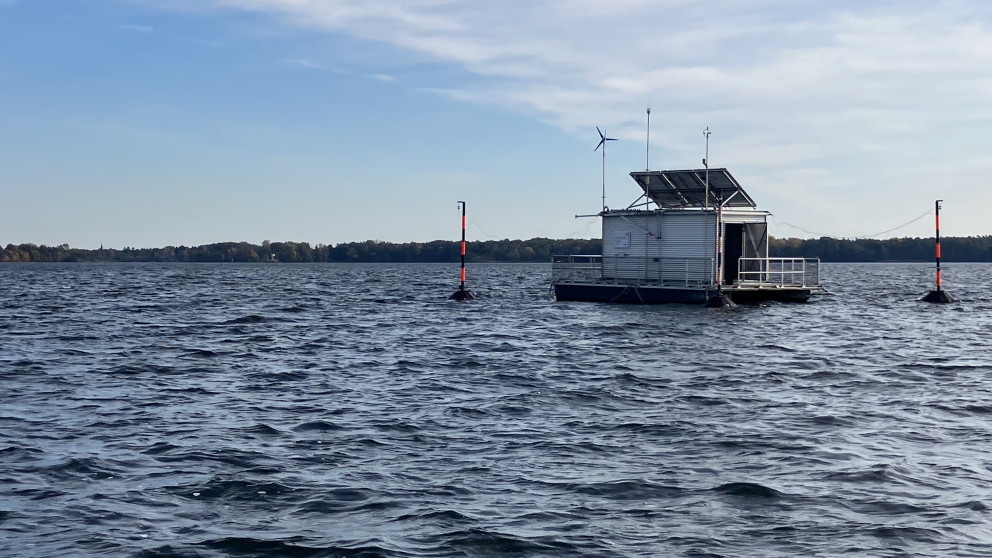
We took one of the IGB’s small motor boats around the shallower edges of the shallow lake in search of colonies, first of all stopping at the floating monitoring station. The little station evokes a kind of post-apocalyptic cyberpunk flood-future shack, with its concisely utilitarian form, extending solar panels and various sensor probes around and beneath it, continually collecting data from the lake environment.
On reaching our next stop, a mussel hotbed close to the shore, the colony’s spreading darkness against the pale, sandy bottom was easy to spot thanks to their incredible filtering capacity that has rendered the freshwater crystal clear (they are not all bad; in fact, they also remove many toxic algae from the environment). Jonas was able to scoop samples up easily with a net, and I could see up close how they attach to each other in twisty shell-sculptures and how much their shell shapes vary individually; as I learned, this is a mussel species with an unusual degree of variation between conspecifics. They are roughly triangular, small wedge-like, semi-conical forms with dark stripes curving around.
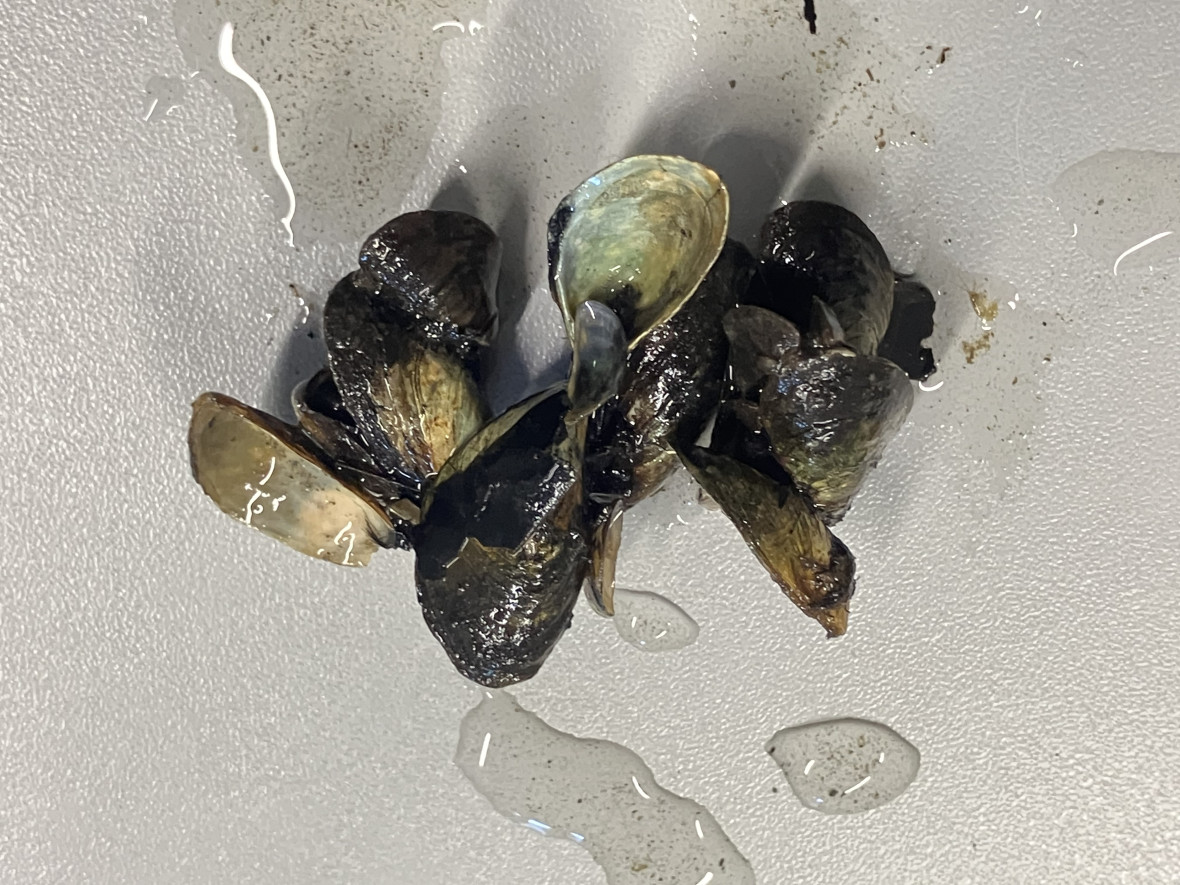
We took the samples back to a lab located in a strangely appropriate adapted beautiful old waterworks building. The samples are used to model the mussels’ behaviour and impact on the lake under different conditions, including the impact of increasing water temperature on their capacity to filter and clean the water. As the mussels do not seem to be going away any time soon, it is useful to understand their potential long-term effects on the lake ecosystem, both good and bad. Although they over-extract nutrient resources, they are also very efficient water filters that keep the water clean and clear of some kinds of toxic algae; however, as the water temperature rises, they become less efficient until they eventually stop filtering. As Jonas explained, Müggelsee is a useful ecosystem for modelling possible future scenarios - there is high-quality data going back decades and as a shallow lake it is especially sensitive to temperature changes (warming rapidly in the summer). Given the likely increasing temperatures and freshwater scarcity in the next few decades leading to shallower waters, rather than a continental waterworld, this offers a window into possible futures of water in Berlin. Although the quaggas and other mussels currently keep this water body clear, there will be a tipping point where they are unable to function effectively if temperatures continue to increase; the waters may then cloud again, yielding ideal conditions for toxic algal blooms to flourish.